Superheroes and sex are inextricably linked. Since the dawn of the superhero comic, the genre has been infused with a sexual suggestiveness that has grown and evolved over time. At first it was very "aw shucks" with its wholesome, preteen male power fantasies that played on every nerdy boy's desire to beat up the pretty girl's mean boyfriend and then...well, something.
But it didn't take long for people to notice, and even less time for them to take advantage. In 1942, Wonder Woman appeared, bringing with her a treasure trove of S&M and control fantasies and legions and legions of copycat heroines. The impossible body proportions and skimpy outfits many mature readers complain about is not only old news, it may be innate to the idea of the superheroine. What more could one expect from an industry founded by "girlie mag" publishers like Harry Donenfeld?
Eventually, comics will have to move to a more realistic, positive image of women simply to survive, and the companies know this. The Supergirl shorts-law is just the first shot in this direction. For now, though, sexually suggestive imagery involving female characters is all part of the shame, and intelligent readers have learned to ignore it and not let it ruin the reading experience. Flying scissor kicks, costumes with boob windows and heroine-on-villainess fight scenes are for now part and parcel of the superhero game, no matter how juvenile, clumsy, artless, pointless and laughable they may be. Then "Detective Comics" comes along and does it right. And maybe this whole thing isn't so bad after all.
The "Batwoman" feature in "Detective Comics" uses sexual imagery in a way that may not have been seen before in mainstream comics. Like William Moulton Marston's Wonder Woman, it takes advantage of the malleable language of comics to present two images at once: what is happening, and what is really happening. Wholly unlike Wonder Woman is the sense that Batwoman's odd sexual energy leads to a greater understanding of the story.

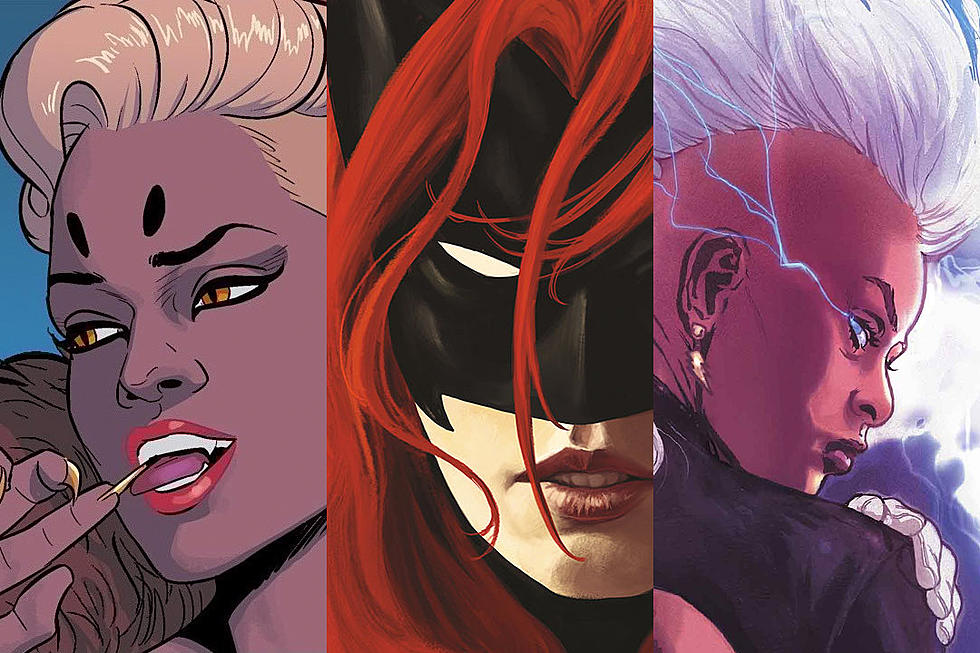
When Batwoman first appears, she bleeds an insignia of color into a black and white world, and then is suddenly everywhere at once. Artist J.H. Williams, as ever, has a rare gift to drag the reader into his vision, a sluggish fractal tilt to his work that hypnotizes. Batwoman is something to behold in her black latex suit and bullet bra, and she immediately begins doling out pain. She digs her bootheel into a street thug, beats him up, threatens him, degrades him. Just as quickly, in the last panel on page 4, the image softens and she takes on the role of benevolent savior, promising not to let anyone hurt him if he just whispers something in her ear -- a "safe word" if you will.

As her adventures continue in "Detective" 854 and 855, the reader is treated to an array of images that, while never explicit, hint at sexual acts and behaviors, typically in Batwoman's interactions with other women. She drags a female member of the Religion of Crime by the hair and bends her backwards. Note the suggestive placement of Batwoman's left hand.

In her struggle with Alice, the new leader of the Religion of Crime, there are several panels that could easily be construed as sexual. As Batwoman leans in to removed Alice's sidearms, her hands are placed dangerously close to her breasts; she sneaks her hand in to relieve Alice of the knife strapped to her thigh, and Alice responds by licking at her lips.

It can be argued that any panel can be taken out of context, unintentional, subject to the psychological whims of the readers and so on. That's an entirely different discussion. Just for fun, let's assume that all of this really is happening and that it's intentional. What would that mean?
Writer Greg Rucka is known for writing uncannily strong female characters. Through an unwavering commitment to the details he has built rich, compelling characters of Carrie Stetko, Tara Chase and Renee Montoya, and it looks like Batwoman, a.k.a. Kate Kane, will probably added to that list. When Kane first appeared in "52," most negative reactions to her sexuality were the usual ignorant message board fare, which is somehow both typical and surprising. Above the twisted snarl of a million mouth-breathing troglodytes, however, an interesting point was raised: isn't this just another male fantasy? The lipstick lesbian?

The Kate in "Detective" is far removed from the elegant socialite with familial guilt from "52." As the story transitions from Batwoman to Kate, Williams' art unscaffolds and breaks down into neat little boxes, as regimented and arranged as her life. After being stabbed in the heart, Kane seems to be in some sort of identity crisis, not entirely sure of who she is: the Suicide Girl personality with her soon-to-be-ex, the tomboy with her father, the soldier with the Airborne tattoo, or Batwoman. And the trauma of her injury seems to awaken old issues.
And this is where the theory gets really interesting...
One of the reasons Lewis Carroll's "Alice in Wonderland" has endured as a classic tale is its wild psychological resonance, as though it were specifically created to tickle the subconscious. The amount of interpretation put into its dreamlogic probably even rivals "Oedipus": there are entire college courses dedicated to its study. The details differ from opinion to opinion, but just about everybody agrees: It's about sex. Most seem to believe that it represents a pubescent girl's sexual awakening, and the strange world of pleasure and danger that awaits. Freud's analysis was that Alice was lesbian. Others still are convinced it's about abuse.

Did Rucka choose to introduce the "Alice in Wonderland" references to hint at further revelations? These hazy, washed out memories that appear – a girl with a sack over her head, a woman being torn away from her daughter, the soldier strapped to the chair – certainly give the theory weight. Is the sex in the images just a visual doorway into a discussion of sexual identity? Are the hidden words in pages 14-15 (855) given further significance? Are we in the rabbit hole?

Rucka and Williams are each rare, meticulous talents who don't seem to do anything accidentally. Is "Batwoman" manipulating our acceptance of sexist behavior in comics to portray the harm that it causes? Do I just need to get laid?
Really, it doesn't matter. (I'm cool) What matters is that it's good, good enough to get you thinking, and only exceptional work does that.
And if this is all crap, Rucka and Williams should adopt it as part of the legend anyway. That might get me laid.
Network: 


Comments:
(33)Add a comment
Monday 24 August
By JK
"The impossible body proportions and skimpy outfits many mature readers complain about is not only old news, it may be innate to the idea of the superheroine."
The implications of this comment bother me greatly. Female roles throughout our culture are defined as sexual, because women have been held in our culture to exist only for the purpose of fulfilling men's desires. If the portrayal of women in superhero comics seems particularly flagrant, this may be due to comics' reputation for exaggeration in general. Like the rest of our culture, however, superheroines certainly can be fixed - can become full characters, as women must be understood (and accepted) to be full people. Misogynistic portrayals need not be innate, no matter how far back they go. This sort of language is often used to dissuade those of us who would like to see superheroines realize a fuller potential - i.e. "just give up, because it's not going to change; it's innate."
"uncannily strong female characters"
There you go again. Why is it "uncanny" for a female character to be strong? If you meant "strong, and also uncanny," you might wish to look to your phrasing.
Your overall point is interesting (and, I think, only time will tell whether you're on to something - it certainly seems possible). However, when you're discussing a topic as fraught as the sexualization of the superheroine, you might want to examine the manner in which you're framing the issue. The phrasing I've cited is probably just awkward, but given the topic, the potential implications are difficult to ignore.
Reply
Tuesday 25 August
By John Parker
I see what you mean, but I stand by the ideas. I think that the sexuality of the superheroine really is innate to the idea, simply because the superheroine was borne out of that sexual context. Doesn't mean it can't change some day, but even then, change would be as a response to the initial sexual context. But again, I see your point.
Wednesday 26 August
By demasialex
I understand where you're coming from in terms of how that can appear sexist and chauvinistic. Two years ago, as a fifteen year old girl, I picked up a copy of Supergirl, and was floored by the amount of sex that showed up in nearly every panel. Thing is, it didn't stop me from reading, becoming a fan, and then picking up other comics with strong leading ladies. The truth is, the fact that super heroines can prance around in tiny shirts and costumes with boob-windows, and still play in the big leagues, fighting as equals with the most macho of our culture's fictional men (super heroes, of course) and maintain their respect, is of of the more forward thinking things I've seen. No one has an issue when men make the most of their sexuality, and no one in the comic world berates girls for it. Without (or maybe with) realizing it, maybe there's a little feminism there. After all, who in their right mind would ever call Wonder Woman an dumb slut?
Sunday 13 September
By Joseph F
Uncannily female characters are called such because the average female is weaker than the average male. Any female that can do the things BAtwoman can do is uncannily strong, especially for a woman.
Monday 21 September
By Laughing Collie
Joseph F.: You have only half the story there. If you look at a bell curve of women's strength overlaid over another bell curve of men's strength, it is true that *on average* (that is to say, much but not all of the time) men are stronger than women... but also that men are *weaker* than women. The male bell curve is taller and wider than the female one, because evolutionarily speaking, due to the physical demands of childbirth, women have genetic parameters beyond which they will die when giving birth. Evolution can experiment with men, on the other hand -- and so on average men are both shorter and taller, weaker and stronger than women.
So feel free to brag about men being on average stronger, if you want. Just don't forget they're on average weaker too. Cheers! :)
Thursday 12 November
By AcornArmy
"Joseph F.: You have only half the story there. If you look at a bell curve of women's strength overlaid over another bell curve of men's strength, it is true that *on average* (that is to say, much but not all of the time) men are stronger than women... but also that men are *weaker* than women."
This fits with something I learned recently, that men and women have different statistical clusters when measuring IQ. The average intelligence for both genders is the same, and the high and low points are the same, but men are more likely than women to diverge from the average, in both directions. The smartest women have IQs as high as the smartest men, and the stupidest women have IQs as low as the stupidest men, but there are fewer women at either extreme than men.
So, you're less likely to meet a very stupid woman than a very stupid man, but you're also less likely to meet a genius woman than a genius man. It almost seems like men are handling the trials for genes governing intelligence, as if males are the gender our race naturally uses for experiments in heredity.
Sunday 13 December
By Karine
I believe the reference to the "uncannily strong women" means that the *writer or artist* has an uncanny ability to know exactly how to do the strong character.
It does not imply that the female of the species can't be strong, but that the *originator* of the *character*has an unusual ability to bring out that side of the charaqcter!
Wednesday 16 December
By lolwut
I( think you've been alone with those comics too long, author. I didn't see all this 'suggestion' you spoke of, or these provocative hand gestures. You are making something out of nothing, and even if I'm wrong, who cares? These are comics for ADULTS, who can handle a little suggestive nuance, and even like it sometimes...but you'd know more about that than me, i suppose.
Monday 24 August
By The Nerdy Bird
Wow, great article!
I can believe you spotted those words. I can make out Fear and Damaged in the first two but what do the others say?
Reply
Monday 24 August
By uncle aimee
revenge and destiny