The most recent issue of "X-Factor" ended with two male team members, Shatterstar and Rictor, making out. While we'll have to wait till next month to find out whether they're gay, bisexual, or it's some sort of mind-control plot point, consider writer Peter David's track record of supporting gay characters in comics -- and the lesser-known fact that writers planned for the pair to hook up back in the mid-90s.There's a good shot this is the start of a whirlwind romance.Yet Mainstream comics haven't always been so progressive. The Comics Code Authority was created in the 50s partly out of paranoid fears that Batman and Robin were secret gay lovers, and forbade homosexuality as a "sex perversion" until 1989.
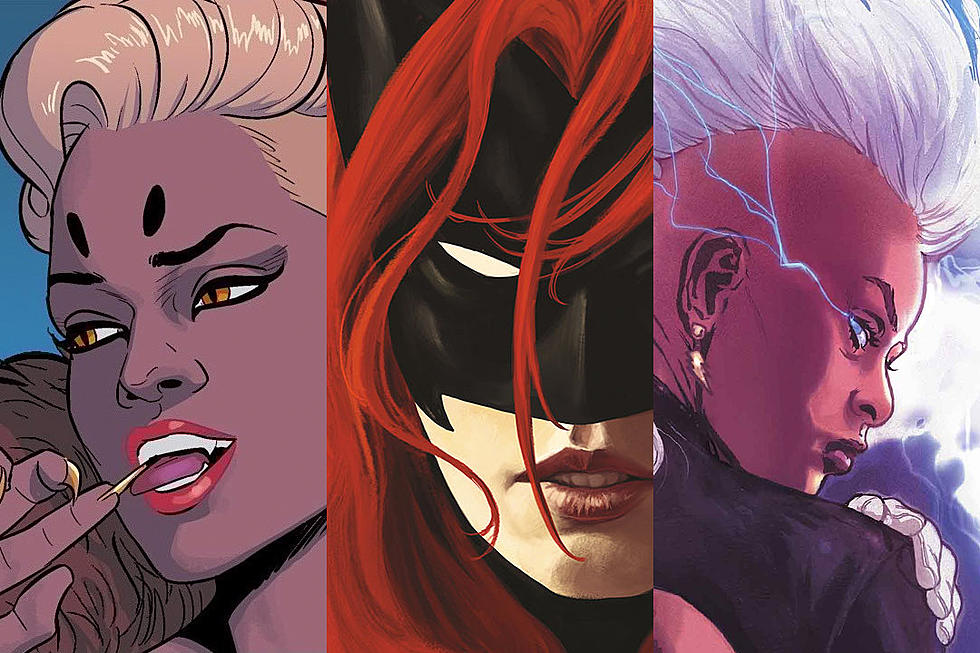
In honor of the "X-Factor" liplock -- and recent promotion of the crime-fighting lesbian Batwoman to the helm of "Detective Comics" -- here's an overview of the most important gay characters in comics, and how attitudes in the industry have changed from censorship to celebration.

"Alpha Flight" hero Northstar broke ground as one of the very first high profile gay superheroes in comics, although his path out of the closet was not an easy one. Writer John Byrne's original idea to make him gay was stymied by the "no gays in Marvel" comics edict of then Editor-in-Chief Jim Shooter, making his sexuality something that could only be implied, not acknowledged.
Years later, Northstar contracted an illness that was intended to be AIDS, but editors quashed the storyline and decided that instead of AIDS, it was actually a magical disease that could be healed by going back to his magic homeland. No, that isn't a joke.
In 1992, Northstar finally came out, an announcement that made mainstream news. Despite their step forward, the Marvel Comics of the day didn't seem very happy with the publicity, and as current "X-Factor" writer Peter David said at the time:
"The message being delivered to the American public was clear. Someone high up, probably very high up (certainly higher than [editor Tom] DeFalco) was extremely embarrassed by the story. Here various news agencies were ready to heap praise upon Marvel for daring storytelling, and the silence of Marvel's response was positively ringing. Not only did Marvel Corporate not seem proud of their achievement, but instead they came across as hoping that it would all die down very quickly."Northstar's sexuality was then ignored for the rest of the series, and not addressed again directly until he joined the X-Men in the early 2000s.

Like Northstar, Apollo and Midnighter weren't introduced as gay, although breadcrumbs were dropped until their relationship finally came out into the open in 2000. Both were members of the DC/Wildstorm team The Authority, and the pair didn't just become a gay couple, but a married gay couple who later adopted a child and were making out in front of readers long before Rictor and Shatterstar kicked it up a notch.
With Apollo's invulnerability, flight, and heat vision, and Midnighter's hyperviolent fighting skills, Apollo was also a clear analog for Superman, and Midnighter for Batman -- a spin on the famous DC Comics partnership that Frederic Wertham surely would have loved.

In 2003, Marvel decided they were going to revamp the 1950s gunslinger The Rawhide Kid by making him gay in a new series called "Rawhide Kid: Slap Leather." He became the first gay title character in a comic, but in a move that prompted criticism from gay supporters, Marvel released the comic -- which had no more violence than mainstream books, only indirect references to homosexuality, and no sex at all -- as an Adults Only MAX title, with the warning "Parental Advisory Explicit Content."
The content it referred to, of course, was gay innuendo and double entendres, like the Rawhide Kid's frighteningly explicit comment that "[the Lone Ranger's] mask and the powder blue outfit are fantastic. I can certainly see why the Indian follows him around."

Originally a cartoon character from "Batman: The Animated Series," Latina policewoman Renee Montoya made her way into the "Batman" comic, but didn't come into her own until 2003's "Gotham Central," a stunning, gritty police procedural comic about what it's like to be a beat cop in a city haunted by insane mass murderers and dark angels.
Unlike most other gay characters, Montoya did not come out, but was outed (and framed for murder) by Two-Face, leading her coworkers to mock her and her conservative family to disown her -- and many readers seemed to want to do the same.
As writer Greg Rucka said, "People got angry at this story. They accused me ... of all sorts of things... Most ridiculous to me was the accusation that we 'made' Montoya gay. As far as I'm concerned, we did no such thing. She was always gay. We were simply the first story to actually say so, and to say it in no uncertain terms."
Montoya left the force and later became The Question after the original hero died of cancer. She currently has a backup feature in "Detective Comics," after the adventures of her former lover Batwoman.

"Young Avengers" characters Hulking and Wiccan were not only revealed as a gay couple in 2005, they were created by openly gay comics and television writer Allan Heinberg ("The O.C.," "Grey's Anatomy"). Although Hulkling was originally pitched as a female shapeshifter who posed as a man, Heinberg later approached his editor about portraying him as a gay man instead, and in a sign of the changing times got the go ahead.
Unlike another shapeshifting Marvel character, Xavin, who often shifted into a female form for his lesbian girlfriend Karolina, Heinberg said that "it's actually meaningful to me that someone like Hulkling -- who has the ability to change shape, to hide, to appear 'normal' -- doesn't. He simply is who he is."
Although some readers complained about the relationship, many others wrote in support, including one fan who said, "Five years ago I could have been that 16-year-old 'Young Avengers' reader who says, 'Wow, these kids are my age, they're openly gay, and they're being accepted. Maybe I don't need to commit suicide.' "

In 2006, Batwoman underwent one of the most dramatic and controversial retcons in comics history, transforming from a hyper-feminine Silver Age character who was created expressly to reaffirm the heterosexuality of Batman -- and who constantly fantasized about being his girlfriend while fighting crime with lipstick and charm bracelets -- to the ass-kicking heroine who just took over "Detective Comics" from no less than Batman himself.
If you're not reading the new run by Greg Rucka and J.H. Williams, their first issue is still on the shelves, and it's scary beautiful -- like the lady herself.
There are plenty more examples, of course, including Pied Piper, Obsidian, Freedom Ring, Terry Berg, Ultimate Colossus, Lord Fanny, Phat and Vivisector, Maggie Sawyer, Josiah Power, those three characters from "Watchmen," and the countless others like Shatterstar and Rictor who are able to follow them now that the doors to the comic book closet have been opened.
Vampires -- In Space! Or the Future! Or both! At io9!
Watch the Saturday Morning Watchmen cartoon at Gorillamask.
A preview of the all-new Adventure Comics at DC Comics!
Network: 


Comments:
(123)Add a comment
Thursday 02 July
By David
I know what you mean barb. I get sick everytime I see heterosexuals kissing in public or holding hands. Why can't they keep that stuff in their homes?
Thursday 02 July
By djbakon
Lets not forget Peter Milligan and Mike Allred's fantastic X-Force/X-Statix...Phat and Vivisector were gay. They weren't your typical homosexual heroes, but media obsessed, money driven, egotistical gay heroes - which made them even more fun to read about!
Reply
Thursday 02 July
By Laura Hudson
I didn't forget about them... That's why I mentioned them in the last paragraph. :)
Thursday 02 July
By Kiel Phegley
Whenever these talks come up, it makes me think of how when I was 12, the first positive gay character I saw in ANY media was Pied Piper in Flash. When I grew up I really appreciated how his relationship was played (rightly) as a very normal one and not something hinted at for tongue-in-cheek laughs or anything. I'm not sure if it was Bill Loebs or Mark Waid who established that about the character, but it was always part of the storyline from the late '90s on.
Come to think of it, the treatment of Maggie Sawyer in the Superman books was pretty similar.
Reply
Thursday 02 July
By Richard Ashcraft
Frankly, even though I'm a homosexual, I'm not much of a fan of gay comic-book characters. The "are they or aren't they?" situation is a dull tease and has been done to death. And there is a lot of negative gay superhumans alone in the DC Universe.
Writer Denny O'Neil reintroduced the Joker as a deadly menace in a 1972 Batman book that had lots of homosexual references (i.e. sucking on a cigar, being eaten {albeit by a shark}, etc.). Denny even mentioned that he wanted the Joker to be gay in that story.
Superman's evil counterpart, Ultraman of the Crime Syndicate of Amerika, is bisexual. Ultra originally appeared in the 1960s. And Obsidian went on an evil rampage before winding up as the boyfriend of Manhunter's personal assistant. (Uh, Marc Andreyko, shouldn't Obsidian still be in jail for his crimes?) The Pied Piper of the Flash's enemies later turned out to be gay. There was even speculation that the original Dr. Mid-Nite and the Atom were gay.
I can tolerate an original character being gay, but leave the already established characters alone. That just ruined the fun times I had reading about them in the silver age.
Reply
Thursday 02 July
By Mike
Gay references such as smoking a cigar and being eaten by a shark? What exactly is the etcetera for? I'm guess less relevant innuendos. Can you please explain how smoking cigars and being eaten by a shark is gay? And don't give me some sort of twisted symbolism either.
Thursday 02 July
By WBG
I agree with you! I'm all about diversity in comics but leave the ones who are already there alone!
Thursday 02 July
By Audrey
Many people have the opposite complaint, that when characters are gay it's "thrown in their face". So, creators can't introduce a character as gay (and really, the idea that that's the first thing you know about the character, like Batwoman, usually means there's nothing else to the character) ...and they can't reveal an established character as gay because that's "turning them gay".
Someone will always complain.
Sunday 05 July
By Doop
Obsidian stopped being a villain back in 2003, three years before he came out in Manhunter.
Sunday 05 July
By Richard Ashcraft
Mike, I first read the story in 1974 in Australia, which printed DC Comics about two years later than the USA editions. When I bought the book, The Greatest Batman Stories Ever, Denny O'Neil explained how he wanted the Joker to be gay in his return to violent crime.
The Joker's victims were stereotypes of gay men. And how they died were examples of the gay life-style. A boxer died from drinking poisoned liquids, which could be hidden versions of semen or urine. A slightly-built nerd died sucking on a cigar that was laced with nitro-glycerine. A young man with long hair was hanged, aka sexual strangulation. An old actor/sugar daddy was thrown into a tank with a shark, but Batman saved him. Batman caught the Joker who had slipped on an oil slick on the beach. So we had lubrication catching the crook in the end, pun intended.
Totally ruined my childhood memories of that story with Denny's revelation. And I was very insulted as an adult that he equated homosexuality with deadly criminals. Way to go, dude.
Of all the gay super-heroes I've seen, only Spectral of the Strangers impressed me. The heroes were given powers based on their personas (similar to the Fantastic Four), and since he was gay, he was given rainbow powers. Plus, he had a steady boyfriend that he introduced to the team. This was during the time of the Ultraverse Comics in the early 1990's.